

Academic experience
September 2020 - July 2023
September 2020 - July 2021
September 2019 - July 2020
September 2016 - July 2020
In September 2020, I began studying BA Latin American studies, still at Leiden University, to pursue deeper knowledge of this region as my interest in Sino-Latin American relations had grown. The program has a wide range in topics, yet special focus lays on Spanish language acquisition. I graduated in July 2023.
I majored in MA Asian studies in July 2021. During the program, I focused on East Asia, PR China most specifically, opting to study international relations in Chinese modern history. My master thesis analysed the historical roots of PR China and Taiwan's rivalry in securing international recognition amongst Central American states, focusing on the late Cold War period.
In the school year 2019-20, I studied at a secondary teacher program at ICLON, Leiden, where pedagogy, subject didactics, and other courses were taught, in order to learn how to teach Mandarin at high-school level. For the entire year, I interned as a teacher at a gymnasium in Hilversum, teaching Mandarin classes to students.
In 2016, I began studying China studies in Leiden, the Netherlands. During my studies, I increasingly focused on modern history and visual arts. Naturally, most time was spent on studying Mandarin. In 2018, I spent a semester studying at Taipei University (師大). In January 2019, I wrote my bachelor thesis on the influence of the Dutch East Indies' Chinese community on diplomatic negotiations on extraterritoriality rights between the Republic of China and the Netherlands in the first half of the twentieth century.
Background image: An advertisement for a Chinese restaurant near San Isidro de El General in Costa Rica (2023).
Studies
Chinese Studies
Before finishing high school, I had already gained an early interest in studying foreign cultures and languages, perhaps thanks to the privilege of being able to travel to several countries outside of Europe in my childhood. In that time, I visited mostly countries in Asia and Latin America. For this reason, it may not really be that much of a coincidence that I ended up studying those regions.
During my final year at high school, I knew that I wanted to study a non-Western language and culture. I considered several, including Russian and Japanese, but ended up at Chinese, without any good rationale. Mostly, I just wanted to study a complicated language. I knew close to nothing about China when I started studying Chinese studies in 2016—I barely knew the names of its capital and its president. Actually, I also had no idea if I would even like studying Chinese.
I had no previous ties to China: I had not been there, nor had I at any point had any form of special interest in the country.
Before 2016, I could not have told you what the difference is between Mandarin and Cantonese, or what dumplings are. Still, I
gained an interest in China pretty quickly. During the first years of my studies, most attention was on language acquisition, and this especially took off during our Spring 2018 semester at Taipei University (师大).
Our Taiwanese classes were laser-focused on further improving our language skills. Besides this, living in Taipei and travelling throughout the country enabled me to learn about Taiwanese culture and just experience how it is to live in another part of the world. In 2018, I also travelled through mainland China, trying out conversations with Chinese people (see photo) and experiencing daily life on the mainland. I think it was here that I realized that I made the right choice in studying China.
Throughout my bachelor, I increasingly focused on (modern) history, including some art history. In 2019, I wrote my bachelor’s thesis on the Indo-Chinese community in the Dutch East Indies in the first half of the twentieth century, and, drawing from archival documents, I concluded that this community was pivotal in the difficulties of diplomatic consulations between the Dutch and Chinese governments in the 1930s and 1940s about ending colonial-era extraterritoriality rights for Dutch citizens on Chinese territory.
Teaching
In 2019, after completing my regular bachelor’s program, I pursued a teacher qualification at ICLON, learning how to teach Mandarin classes at high-school level. Teaching had interested me for some time, and I quickly realized that I really liked it. At the same time, I started teaching seminars at Leiden University to first-year Chinese studies students as a course assistant. The seminars were part of a course on contemporary Chinese politics, economy, and society. By starting both at the same time, I had ample time to practice teaching methods, and I was able to learn what parts of educating I liked.
From 2019 to 2023, every first semester of the academic year I worked as the course assistant. Besides teaching seminar sessions, I was also responsible for the course assessment, i.e., grading of exams and papers. During the seminars, besides providing introduction to academic skills, we discussed a broad array of Chinese studies. This ranged from the post-Mao economic reforms to the construction of the Great Firewall, and from the Belt and Road Initiative to the problematic urban–rural divide.
Asian Studies
In 2020–21, I studied the MA Asian Studies, focusing on East Asian studies specifically. Like in my bachelor program, I opted for courses on modern history as much as possible, together with more language acquisition courses. In the summer of 2021, I finished my master’s thesis on Chinese relations with Central America. In my thesis, I argued that the remarkable reluctance of Central American states to still side with Taiwan (ROC) over China (PRC) has its roots in the late Cold War, and presented four factors that account for local decision-making in the recognition rivalry between both Chinas.
Latin American Studies
Simultaneously, in 2020 I began the BA Latin American Studies. Having travelled to the region
with family before graduating from high school, this was a region I had a natural interest in.
Moreover, I thought it would be interesting to focus on a particular aspect of China’s interna-
tional relations, and in order to focus on Sino-Latin American relations, more knowledge of
the region itself would obviously be necessary. I also wanted to be able to speak Spanish. In
Summer 2023 I graduated from this program, concluding with a third thesis. This thesis built
on a discourse analysis of media and political discourse in two Central American states, Costa
Rica and Honduras, and examined which narratives about China, the U.S., and their great-
power rivalry have emerged in these countries in the period 2018–23.
Research traineeship
In 2023, I also participated in a research project as a trainee. We did research on the new
constitutions of Bolivia and Ecuador (2008–09), how they are bringing the idea of plurinatio-
nalism in practice, and how they relate to the rejected new plurinational constitution in Chile
(2021–22).
(Note: Since 2024, I work at the Ministry of OCW in the Hague.)
In Spring 2018, talking to a Shandongnese woman about her reasons to climb the stairs to the top of Taishan (泰山), an important Buddhist mountain in Shandong, near Tai'an.

In Summer 2018, looking out over the southern port city of Mokpo, Korea

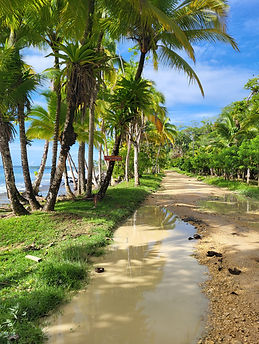
Along the road on the main island of Bocas
del Toro in Panama (2023).
Personal introduction
On this page, I would like to tell a bit more about myself. As you will see, although my interests are very (sometimes annoyingly) broad and practically cover the entire globe and multiple aspects of our societies, there is a baseline. From very early on, I have been interested in foreign languages and cultures, and I have always wanted to understand more about other peoples and ways of living, conscious that our (Western) way of thinking and acting is just one of many.